
El Repositorio Digital del Observatorio sobre Tecnologías Digitales, Estrategias Sindicales y Mercado de Trabajo en Argentina constituye una iniciativa conjunta del Centro de Innovación de los Trabajadores (CITRA, CONICET–UMET), la Universidad Metropolitana para la Educación y el Trabajo (UMET) y las organizaciones sindicales: Asociación Gremial de Computación (AGC), Asociación de Empleados de Farmacias (ADEF), Asociación del Personal Legislativo (APL) y Sindicato del Seguro de la República Argentina (SSRA).
El Observatorio se enmarca en el programa UMET Investiga 2024–2025, impulsado por la Secretaría de Investigación y Desarrollo de la UMET, conforme a la Resolución del Consejo Superior N.º 94/2024, que promueve la generación, sistematización y difusión del conocimiento científico orientado a los desafíos del trabajo y las transformaciones tecnológicas contemporáneas.
Este repositorio es una plataforma de acceso abierto que recopila y analiza información sobre el impacto de las tecnologías digitales en el empleo y la negociación colectiva. Reúne legislación, estudios comparativos, datos productivos y estrategias gremiales, facilitando el diálogo entre actores sindicales, académicos, tecnológicos y políticos para comprender y enfrentar los desafíos de la digitalización.
Últimos ingresos
-
Repelled at first sight? Expectations and intentions of job-seekers reading about AI selection in job advertisements
Artificial intelligence (AI) is increasingly used in personnel selection to automate decision-making. Initial evidence points to negative effects of automating these procedures on applicant experiences. However, the effect of the prospect of automated procedures on job-seekers’ pre-process perceptions (e.g., organizational attractiveness) and intentions (to apply for the advertised job) is still unclear. We conducted three experiments (Study 1 and Study 2 as within-subjects designs, Study 3 as a between-subjects design; N1 = 36, N2 = 44, N3 = 172) systematically varying the information in job advertisements on the automation of different stages of the selection process (Study 1: screening stage conducted by a human vs. a non-specified agent vs. an AI; Study 2 and Study 3: human screening and human interview vs. AI screening and human interview vs. AI screening and AI interview). Results showed small negative effects of screening conducted by an AI vs. a human (Study 1, Study 2, Study 3), but stronger negative effects when also interviews were conducted by an AI vs. a human (Study 2, Study3) on job-seekers pre-process expectations, perceptions, and intentions. Possible reasons for these effects are discussed with special consideration of the different stages of the recruiting and selection process and explored with a qualitative approach in Study 2. -
The Future of Jobs amidst the Rise of Artificial Intelligence: How ready are Asian Undergraduates?
Artificial Intelligence (AI) could have far reaching impact on economies and societies across the globe. The current avalanche of technological changes across the workplace demonstrated by AI has rekindled widespread fear of job losses and increase in inequality. This study sets out to analyze the perceptions of Asian undergraduates towards the increasing development of AI technologies in the workplace and assess how confident and adaptable they are in relation to challenges of AI as a viable future job competitor in the labour market. A survey instrument was administered randomly to 84 respondents from Yogyakarta State University and descriptive statistics was used in analyzing the data. The findings from the study revealed that more than 70 percent of respondents possess satisfactory levels of self-confidence and adaptability skills to take on the disruptive forces of AI technologies in the future but exhibits mixed feeling as regard to their perception of AI technologies in the workplace as the margin of difference among the three response options provided (Scared, Confident or Indifferent) were so small and below 50% for each option. This study bridges the gap in the literature relating to undergraduate’s perception of AI in the workplace especially in Asia while also providing useful insights and recommendations to ensuring that all relevant stakeholders especially undergraduates maximizes the opportunities brought about by AI while reducing or totally eradicating the threats on their path. -
Robotics vs Machine Learning vs Artificial Intelligence: Identifying the Right Tools for the Right Problems
Understanding the buzz about Artificial Intelligence is critical as it has attracted the attention of the senior finance community. The below body of work defines Machine Learning (ML), Robotic Process Automation (RPA) and Artificial Intelligence (AI), and the necessary knowhow of how it works. The article also addresses the capabilities of AI in helping the financial risk community address processes and tasks that impact their process flow. -
Human vs machine intelligence: How they differ and what this implies for our future society
To be able to predict the impact of artificial intelligence (AI) on the required human competences of the future, it is first and foremost necessary to get an overview of what AI at all is and how it differs from human intelligence. The main goal of this paper is to provide such an overview to readers who are not experts in the area. The focus of the paper is on the similarities and differences between human and machine intelligence, since understanding that is of essential importance to be able to predict which human tasks and jobs are likely to be automatised by AI - and what consequences it will have. -
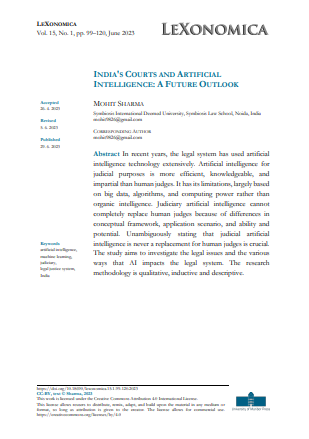
India's Courts and Artificial Intelligence: A Future Outlook
In recent years, the legal system has used artificial intelligence technology extensively. Artificial intelligence for judicial purposes is more efficient, knowledgeable, and impartial than human judges. It has its limitations, largely based on big data, algorithms, and computing power rather than organic intelligence. Judiciary artificial intelligence cannot completely replace human judges because of differences in conceptual framework, application scenario, and ability and potential. Unambiguously stating that judicial artificial intelligence is never a replacement for human judges is crucial. The study aims to investigate the legal issues and the various ways that AI impacts the legal system. The research methodology is qualitative, inductive and descriptive. -
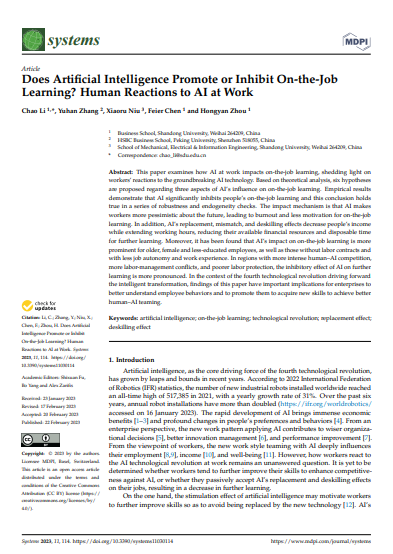
Does Artificial Intelligence Promote or Inhibit On-the-Job Learning? Human Reactions to AI at Work
This paper examines how AI at work impacts on-the-job learning, shedding light on workers’ reactions to the groundbreaking AI technology. Based on theoretical analysis, six hypotheses are proposed regarding three aspects of AI’s influence on on-the-job learning. Empirical results demonstrate that AI significantly inhibits people’s on-the-job learning and this conclusion holds true in a series of robustness and endogeneity checks. The impact mechanism is that AI makes workers more pessimistic about the future, leading to burnout and less motivation for on-the-job learning. In addition, AI’s replacement, mismatch, and deskilling effects decrease people’s income while extending working hours, reducing their available financial resources and disposable time for further learning. Moreover, it has been found that AI’s impact on on-the-job learning is more prominent for older, female and less-educated employees, as well as those without labor contracts and with less job autonomy and work experience. In regions with more intense human–AI competition, more labor-management conflicts, and poorer labor protection, the inhibitory effect of AI on further learning is more pronounced. In the context of the fourth technological revolution driving forward the intelligent transformation, findings of this paper have important implications for enterprises to better understand employee behaviors and to promote them to acquire new skills to achieve better human–AI teaming.